



Things to Do in Galway City Centre — A Local Guide
Things to Do in Galway City Centre — A Local Guide
There are cities that look good on paper and cities that deliver in person. Galway is firmly in the second category. A compact, walkable city centre packed with medieval history, extraordinary pubs, seafood that travels from boat to table the same morning, and a live music scene that operates seven days a week without apology — Galway is a city that rewards time and wandering in equal measure.
This guide was put together with genuine Galway knowledge. No filler, no paid placements — just the areas, attractions, pubs, and restaurants that make a visit to Galway city centre worth planning around. Everything covered here is within easy walking distance of the Eyre Square Hotel on Forster Street.
Start at Eyre Square
Every good Galway visit begins at Eyre Square — or JFK Memorial Park as it’s officially known, though nobody calls it that. This is the city’s central public park, framed by the railway station, shops, pubs and hotels, and filled throughout the year with people making the most of wherever the Galway weather happens to sit on any given day.
Take a few minutes to look at the Quincentennial Fountain — the dramatic bronze Galway Hooker sail sculpture — and the Browne Doorway, a carved 17th-century stone archway that was once the entrance to a merchant family’s townhouse. Both sit quietly in the square and are easily missed if you’re in a hurry. Don’t be in a hurry.
From the south side of the square, take Shop Street westward and you’re immediately in the flow of Galway’s city centre. This pedestrianised street is the main artery of the shopping district and the start of an exploration that could genuinely fill a weekend.
Shop Street and High Street — Shopping in Galway
Galway’s shopping scene runs from the familiar to the genuinely distinctive. Shop Street itself has the usual high-street staples — including TK Maxx for bargain hunters — but the real interest lies in the side streets and independent retailers.
Along High Street, you’ll find the Kilkenny Shop for Irish-made knitwear, ceramics and homeware, and the Galway Woollen Market for traditional Aran woollens and tweed. Fallers Sweater Shop, just off Eyre Square, stocks a fine range of contemporary and traditional Irish knitwear. These aren’t tourist traps — they stock good-quality Irish-made goods at reasonable prices, and they’re far more interesting than anything you’ll find in a Dublin airport.
For independent bookshops, music, and curios, the laneways branching off Shop Street — particularly Kirwan’s Lane — are worth exploring. Kirwan’s Lane is one of Galway’s oldest surviving medieval laneways, fully restored and now lined with cafés and small businesses. In the late 18th century, Richard Martin built a 100-seat theatre here for his wife. Today it’s quieter, but no less atmospheric.
The Latin Quarter
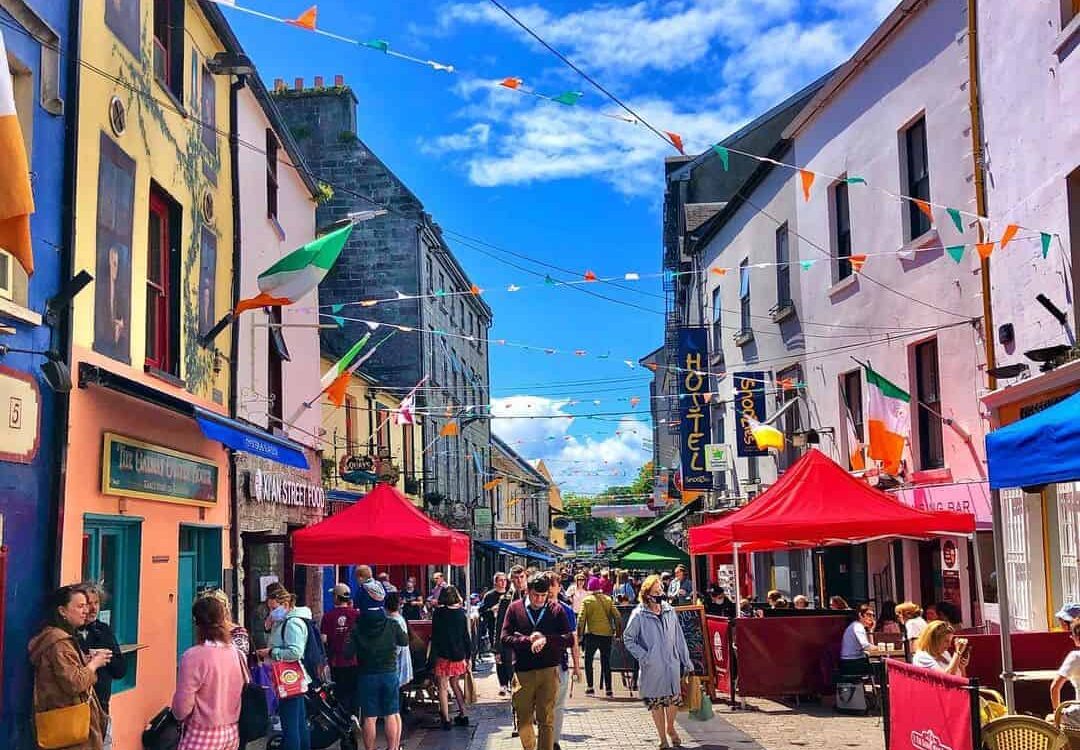
The Latin Quarter is the name given to the cobblestoned web of streets running from St. Nicholas’ Collegiate Church down through Quay Street to the Spanish Arch. It’s the oldest and most characterful part of Galway city, and on any given evening it comes alive in a way that few other urban spaces in Ireland can match.
The quarter hosts elements of virtually every festival the city runs — the Galway International Arts Festival, the Oyster Festival, the Ukelele Festival, the Cúirt Literary Festival — and its pubs host live traditional music sessions daily. Walk through on a summer evening and you’ll hear reels drifting from three different doorways simultaneously.
St. Nicholas’ Collegiate Church
At the heart of the Latin Quarter stands St. Nicholas’ Collegiate Church, the largest medieval parish church in Ireland still in use. Founded in 1320, it is a remarkable building — the stonework is original, the carved baptismal font is medieval, and the atmosphere inside is genuinely solemn and beautiful. Christopher Columbus is said to have prayed here before his voyage to the Americas in 1477, though historians debate the details. What’s not in doubt is that this is one of Galway’s most significant historical buildings, and it’s free to enter.
Quay Street
Quay Street is the most famous street in Galway — a short, curved stretch of cobblestones lined with pubs, restaurants, and shops that has more character per square metre than almost anywhere in Ireland. It’s the street you’ll keep returning to, whether for a morning coffee, a lunchtime crab chowder, an afternoon pint, or a late-night session of trad music. The street is pedestrianised in summer and the outdoor seating areas fill up the moment the sun appears (and often when it doesn’t).
The Spanish Arch
At the southern end of the Latin Quarter, where Quay Street meets the River Corrib, stand the Spanish Arch — two surviving arches from the 16th-century town walls that were built to protect Galway’s quays. The remaining stonework is modest in scale but considerable in historical significance: these walls once defended a city that traded directly with Spain, Portugal and France, importing wine and exporting fish and wool on a substantial scale.
The area around the Spanish Arch is particularly lovely on a sunny day. Locals spread out on the grass by the river, the swans on the Corrib drift past with characteristic indifference, and the views across to Nimmos Pier and the Claddagh are exactly the kind of image that lodges in your memory. The Galway City Museum, housed in a modern building right beside the arch, is free to enter and worth an hour — it covers the city’s archaeology, folk history, and maritime heritage, including a traditional Galway Hooker boat on display.
The Long Walk
From the Spanish Arch, a short stroll along the quayside brings you to The Long Walk — one of Galway’s most iconic and most photographed streets. Don’t be misled by the name: the walk itself is only about 314 metres long. What it lacks in length it makes up for in visual impact — a row of brightly painted Georgian townhouses facing directly onto Galway Harbour, with Nimmos Pier and Galway Bay as a backdrop.
The Long Walk was originally built by the Eyre family in the 18th century to extend the quays and act as a breakwater. Today it’s one of those spots that looks exactly as good in person as it does in photographs. The best view, incidentally, is from across the water at Nimmos Pier — particularly at dusk, when the coloured façades glow against the western sky.
The Claddagh
Just across the Wolfe Tone Bridge from the Spanish Arch lies the Claddagh — arguably the most historically significant neighbourhood in Galway. Once a self-governing Irish-speaking fishing village that stood entirely outside the town walls, the Claddagh maintained its own laws, customs, and elected ‘king’ until the early 20th century. The original thatched cottages are long gone, demolished in the 1930s, but the area retains a distinct identity and a strong community spirit.
The Claddagh is, of course, famous worldwide as the home of the Claddagh ring — the iconic Irish ring featuring two hands holding a heart topped with a crown, symbolising love, loyalty and friendship. The design originated here in the 17th century and has been worn as a betrothal or wedding ring by generations of Irish people and diaspora ever since. A walk along the Claddagh quays offers beautiful views of the River Corrib, the Spanish Arch, The Long Walk, and Nimmos Pier.
Galway Cathedral
Following the riverside path from the Spanish Arch northward, past Nimmos Pier and along the Corrib, eventually brings you to Galway Cathedral — the Cathedral of Our Lady Assumed into Heaven and St. Nicholas. It’s a relatively modern building (construction began in 1958, completion in 1965) but a strikingly beautiful one, designed in a mix of Romanesque and Renaissance styles with a Spanish influence. The copper dome is a defining feature of Galway’s skyline and can be seen from many parts of the city.
Inside, the cathedral is genuinely impressive — soaring arches, intricate mosaics, and stained glass windows that flood the interior with coloured light on a bright day. It sits on the site of the old county jail, which adds a layer of history to an already interesting building. Entrance is free and the cathedral is open to visitors throughout the day.
The Best Pubs in Galway City Centre
No guide to Galway city centre would be complete without an honest account of the pubs. This is, after all, a city where traditional music is a daily occurrence rather than a weekend performance — and where the quality of a pint is taken seriously.
- Tigh Neachtain (Neachtain’s) — On the corner of Cross Street and Quay Street, this pub opened in 1894 and feels it in the best possible way. Dark wooden panelling, cosy corners, memorabilia from another era, and a real fire in winter. On a fine day, the outside corner seats facing onto the Latin Quarter are among the finest spots in the city for people-watching over a pint.
- Tig Chóilí — On Mainguard Street, just off Shop Street. Live trad sessions twice daily, Monday to Saturday, plus two on Sundays. Reliable music, reliable Guinness, reliably busy.
- The Crane Bar — A fifteen-minute walk from Eyre Square on Sea Road, but worth every step. Widely regarded as the best traditional music pub in Galway, with live sessions seven nights a week both upstairs and down. Has been doing this since the 1930s and has no intention of stopping.
- Garavan’s — On William Street, near Eyre Square. A spirit grocery since 1937 and now one of the best whiskey bars in the city. Their tasting platters are exceptional value.
- An Púcán — On Forster Street, steps from the Eyre Square Hotel. High-energy atmosphere with live music and sport seven nights a week. A natural first-night choice for guests staying with us.
- The Quays — A large, lively pub in the Latin Quarter with regular live music and a buzzy atmosphere most nights of the week.
Where to Eat in Galway City Centre
Galway has a food scene well above its size. The city’s position on the Atlantic and its proximity to some of Ireland’s finest farmland means local, seasonal ingredients are the default rather than the selling point.
- Ard Bia at Nimmos — Housed in a historic building on the harbour wall beside the Spanish Arch, Ard Bia is one of Galway’s most celebrated restaurants. Elevated, creative cooking with a focus on local producers. Booking recommended for dinner.
- Kai — On Sea Road, a short walk from the city centre. Widely regarded as one of the best restaurants in Connacht. Seasonal, ingredient-driven, booking essential.
- Aniar — Michelin-starred, located on Lower Dominick Street. Celebrating Connacht produce with a tasting menu format. A special occasion restaurant.
- The Merchant Bar & Restaurant — Our own restaurant on Forster Street, at the Eyre Square Hotel. Modern Irish cooking in a relaxed setting — ideal for a pre-theatre dinner, a post-race supper, or simply a good meal in the city centre without the need to book a taxi.
A Suggested Walking Route
If you have a full day in the city, here’s a natural route that covers the highlights without feeling rushed:
Start at Eyre Square → walk through Shop Street → detour into Kirwan’s Lane → explore the Latin Quarter → visit St. Nicholas’ Church → walk down Quay Street → stop at the Spanish Arch → browse the Galway City Museum → stroll along The Long Walk → cross to the Claddagh → follow the river path to Galway Cathedral → return via the river walk to the city centre.
The full circuit takes two to three hours at a relaxed pace — more if you stop for lunch, coffee, or a pint along the way, which you absolutely should.
Plan Your Galway City Break
The Eyre Square Hotel on Forster Street puts you at the centre of everything covered in this guide. Browse our accommodation options, visit the Merchant Bar & Restaurant, or explore our gallery to get a sense of the hotel before you book. For questions about what’s on in Galway or how to make the most of your visit, our team is always happy to help — get in touch here.

