


Eyre Square Galway — A Complete Guide
Eyre Square Galway — A Complete Guide
Stand in the middle of Eyre Square on any given afternoon and you’ll understand instantly why Galway has earned its reputation as Ireland’s most spirited city. Buskers ring the air with trad music, locals cut across the grass on their way to the shops, tourists stop to take photographs of the Quincentennial Fountain, and a group of students from the nearby university lounge on the benches as if they own the place. In many ways, they do — because Eyre Square belongs to everyone. It always has.
Whether you’re visiting for a weekend city break, en route to the Wild Atlantic Way, or simply looking for a place to find your bearings, Eyre Square is where Galway begins. This guide covers everything you need to know — the history, the landmarks, the events, the best times to visit, and what’s within easy walking distance.
The Eyre Square Hotel sits on Forster Street, directly behind the square — making it the ideal base from which to explore everything this guide covers.
A Brief History of Eyre Square
The history of Eyre Square stretches back to medieval times, when it was an open expanse in front of the town gate where markets and public gatherings took place. For centuries it was the commercial and social heart of Galway — a place where merchants, fishermen, and townspeople converged.
The square takes its current name from Mayor Edward Eyre, who officially presented the plot of land to the people of Galway city in 1710. He planted ash trees and enclosed the park with a wooden fence. In 1801, General Meyrick erected a stone wall around the square, giving it the informal name Meyrick Square for a period. A Georgian-style redevelopment in the mid-19th century added iron railings and formal pathways, shaping much of its character.
The most transformative moment in Eyre Square’s modern history came on 29 June 1963, when US President John F. Kennedy visited Galway and addressed an estimated crowd of 100,000 people from the square. Kennedy, whose ancestors had emigrated from County Wexford, was made a Freeman of Galway City that day — the last public honour he received before his assassination five months later. In 1965, the square was officially renamed John F. Kennedy Memorial Park in his honour, though to this day it is universally known — by locals and visitors alike — as Eyre Square.
A bronze bust of Kennedy now stands in the park, replacing an earlier monument erected at the spot where he made his speech. It remains one of Galway’s most visited and most quietly poignant memorials.
In 2004, the square underwent a major redevelopment costing over €20 million — a project that proved controversial at the time but ultimately won the Irish Landscape Institute Design Award in 2007. The result is the square as it stands today: a thoughtful blend of open green space, paved walkways, modern benches, sculptures, and a children’s playground.
The Landmarks and Features of Eyre Square
The Quincentennial Fountain
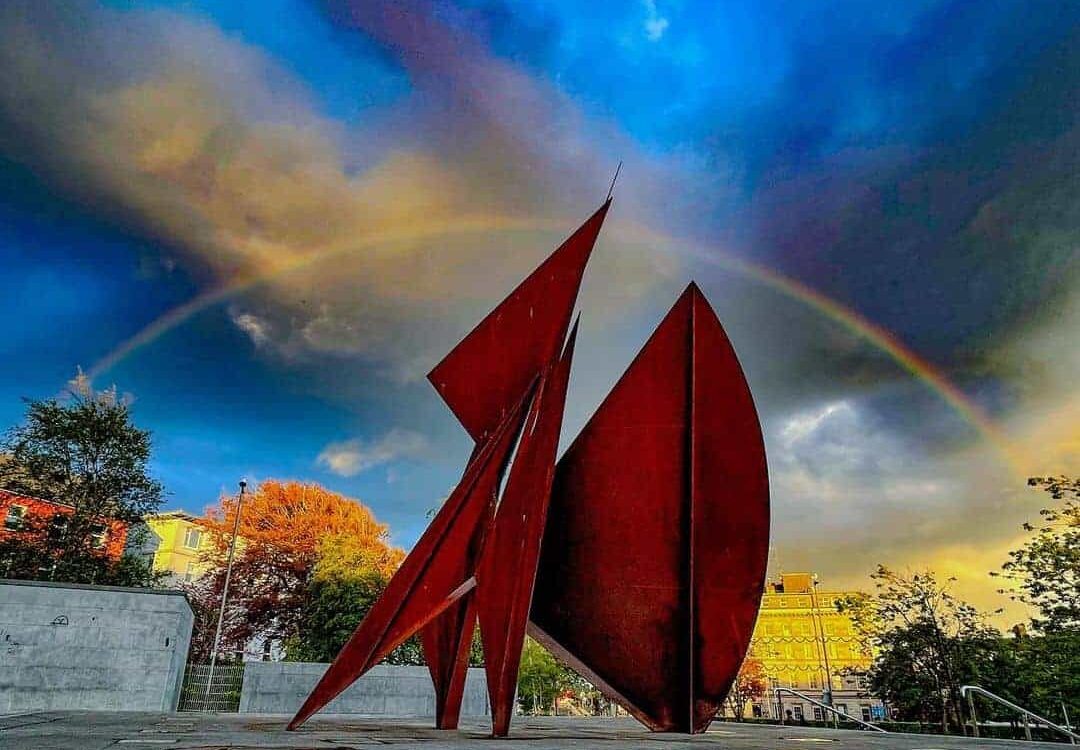
One of the most distinctive features of Eyre Square is the Quincentennial Fountain, built in 1984 to mark the 500th anniversary of Galway receiving its royal charter. The fountain is a striking metal sculpture designed to represent the sail of a Galway Hooker — the iconic traditional fishing boat unique to Galway Bay. Dark in colour and dramatic in form, it stands at the northern end of the square and provides one of the most photographed images in the city.
The Browne Doorway
Tucked into the eastern side of the square is the Browne Doorway — a magnificent carved stone archway dating from 1627, originally part of the Browne family mansion on Lower Abbeygate Street. The Brownes were one of Galway’s famous Fourteen Tribes, the merchant families who dominated the city for centuries. The doorway was carefully relocated to Eyre Square in 1905 and is now a protected historical monument, its carvings still remarkably detailed after nearly four centuries.
The 14 Tribes Flags
During the summer months, fourteen flagpoles at the top of the square fly flags bearing the crests of the Fourteen Tribes of Galway — the Norman and Welsh merchant families whose influence shaped the city from the late medieval period onward. Their names — Burke, D’Arcy, Deane, Ffrench, Font, Joyce, Kirwan, Lynch, Martin, Morris, Skerrett, Bodkin, Blake, and Browne — are woven into the fabric of Galway’s streets and townland names to this day.
The Liam Mellows Statue
Standing near the eastern car park is a statue of Liam Mellows (1892–1922), a soldier and republican politician who played a significant role in the 1916 Easter Rising and the subsequent War of Independence. Born in County Wexford but raised in Galway, Mellows is remembered here as a local hero of the independence movement.
The Children’s Playground
For families travelling with young children, Eyre Square has a well-maintained playground — a genuine bonus when you’re staying in the city centre and need to give little legs a run. It’s popular with local families and generally busy on dry afternoons.
Markets and Events in Eyre Square
Eyre Square has been a market place since medieval times, and that tradition continues throughout the year with a rotating calendar of events that give the square real energy and variety.
The Galway Continental Christmas Market
Without question the most spectacular transformation of Eyre Square happens each winter, when the Continental Christmas Market arrives. Running from mid-November through to early January, the market fills the square with over 50 wooden chalets, a Big Wheel, a carousel, Santa’s Grotto, a German Bier Keller, and a festive atmosphere that draws half a million visitors over the course of the season. The Big Wheel, towering over the square, has become one of Galway’s most iconic winter images. If you’re visiting between November and January, the market is an experience not to be missed — and the Eyre Square Hotel is steps from the festivities.
St. Patrick’s Festival (March)
In 2026, Galway’s St. Patrick’s Day celebrations span four days (14–17 March), with Eyre Square serving as the Festival Village hub. The parade on 17 March passes directly alongside the square on its route from University Road to Prospect Hill — and the viewing area in Eyre Square is one of the best spots to watch the procession. Expect free outdoor concerts, family entertainment, and a city buzzing with colour and craic.
Galway Potters’ Market (May/June)
Each year around the June Bank Holiday weekend, the Galway Potters’ Market returns to Eyre Square. In 2026, it takes place on 30–31 May, with over 25 studio potters and ceramic artists from across Ireland displaying and selling their handcrafted work. Visitors can browse a wide range of porcelain, stoneware, earthenware and raku pieces — or even try their hand at throwing clay themselves. It’s a wonderful, unhurried event that showcases Irish craft at its finest.
Galway International Arts Festival (July)
Running 13–26 July 2026, the Galway International Arts Festival is one of the most important arts festivals in Europe. While the main stages and venues span the entire city, the buzz generated throughout the festival transforms the whole city centre — and Eyre Square sits at the centre of it. Street spectacle, impromptu performances, and festival crowds spill across the square during the two-week programme.
Galway Races (Late July/August)
The Galway Races Summer Festival (27 July – 2 August 2026) is the single biggest event in Galway’s calendar. The city changes character entirely during race week — the pubs are packed from lunchtime onward, racegoers parade in their finest, and a carnival atmosphere pervades every corner of the city. The shuttle buses to Ballybrit Racecourse depart from directly outside The Skeff Bar on Eyre Square, making the square the natural starting and finishing point for race days.
What’s Around Eyre Square?
One of Eyre Square’s greatest assets is its position at the gateway to everything Galway has to offer. Step off the square and within minutes you’re in the middle of one of the most walkable and rewarding city centres in Ireland.
Shop Street and the City Centre
The pedestrianised stretch running from Eyre Square through to Shop Street and beyond is Galway’s main shopping and dining artery. You’ll find a blend of Irish boutiques, independent bookshops, music stores, and familiar high-street names. The real pleasure is in the side streets — ducking into Kirwan’s Lane or exploring the medieval laneways between High Street and Cross Street reveals a different, quieter Galway.
The Latin Quarter
A ten-minute walk from Eyre Square brings you into the Latin Quarter — the cobblestoned heart of old Galway, stretching from High Street down through Quay Street to the Spanish Arch. This is where you’ll find the city’s most celebrated traditional pubs, independent restaurants, and a concentration of live music that is unmatched anywhere in Ireland. It’s the area that most visitors fall instantly in love with, and rightly so.
Galway Railway Station and Bus Station
Galway’s main railway station and Bus Éireann terminal are immediately adjacent to Eyre Square — making it one of the most convenient locations imaginable for visitors arriving by public transport. Trains from Dublin take just under two hours and fifteen minutes, while coaches from all over Ireland pull in directly to the station at the square’s edge.
An Púcán and the Eyre Square Pubs
Forster Street, which runs alongside the hotel, is home to An Púcán — one of Galway’s best-loved pubs for live music and sport. A fifteen-minute walk brings you to The Crane Bar on Sea Road, widely regarded as the finest traditional music pub in the city, with live sessions seven nights a week. The square itself is flanked by The Skeff and O’Connell’s, both spacious and popular with visitors and locals alike.
Best Times to Visit Eyre Square
Eyre Square has something to offer in every season, but the experience changes significantly throughout the year.
Spring (March–May): St. Patrick’s Day brings the city alive around the square in mid-March, and the Potters’ Market in late May adds a lovely artisan atmosphere. May and June are the sunniest months in Galway on average — the square at its brightest and the days at their longest.
Summer (June–August): This is Galway at full tilt. July brings the Arts Festival, late July brings the Races, and the city is buzzing from morning to midnight. Book well in advance if you’re planning a visit at this time — the city fills up quickly and hotels are in high demand.
Autumn (September–October): September is a wonderful time to visit — the Oyster Festival in late September brings seafood, music and celebration to the city, while the crowds of high summer have thinned. The weather remains relatively mild and the city has a calmer, more local feel.
Winter (November–February): The Christmas Market running from mid-November turns Eyre Square into one of the most atmospheric winter destinations in Ireland. Even outside market season, Galway’s pubs, restaurants, and cultural venues make winter a genuinely rewarding time to visit — and hotel rates are considerably more competitive.
Staying Near Eyre Square
For the most convenient Galway city break, staying directly on or behind Eyre Square puts everything at your doorstep. The Eyre Square Hotel is located on Forster Street — a minute’s walk from the square itself, directly above the Merchant Bar & Restaurant — and is ideally placed for exploring the city on foot. The railway station is three minutes’ walk away, the Latin Quarter is ten minutes, and the Spanish Arch is fifteen. You genuinely don’t need a car to explore the best of Galway city from this base.
Browse our rooms and rates, explore the food and drink on offer, or get in touch if you have any questions about your stay. We’d love to have you with us.
Eyre Square Hotel sits right at the heart of what this guide covers. As one of the most well-positioned galway hotels, we offer direct access to the square, the train station, and everything that makes this part of the city so special.

